In short Running EnergyPlus online means using the same validated US Department of Energy simulation engine through a browser, with the model-building automated. Benchmarked against a detailed hand-built model of a Bergamo clinic, the cloud approach landed within 4.8% on heating and 14.0% on cooling, inside the 20% margin accepted for early-stage design (Picco and Marengo, 2019).
What EnergyPlus online actually means
EnergyPlus is the simulation engine developed by the US Department of Energy, and it has been the reference standard for dynamic building energy simulation for two decades. It is robust, validated and free. It is also, in its raw form, genuinely difficult to use: a text-driven engine that expects hundreds of inputs, a correctly constructed geometric model and a user who knows which of those inputs matter.
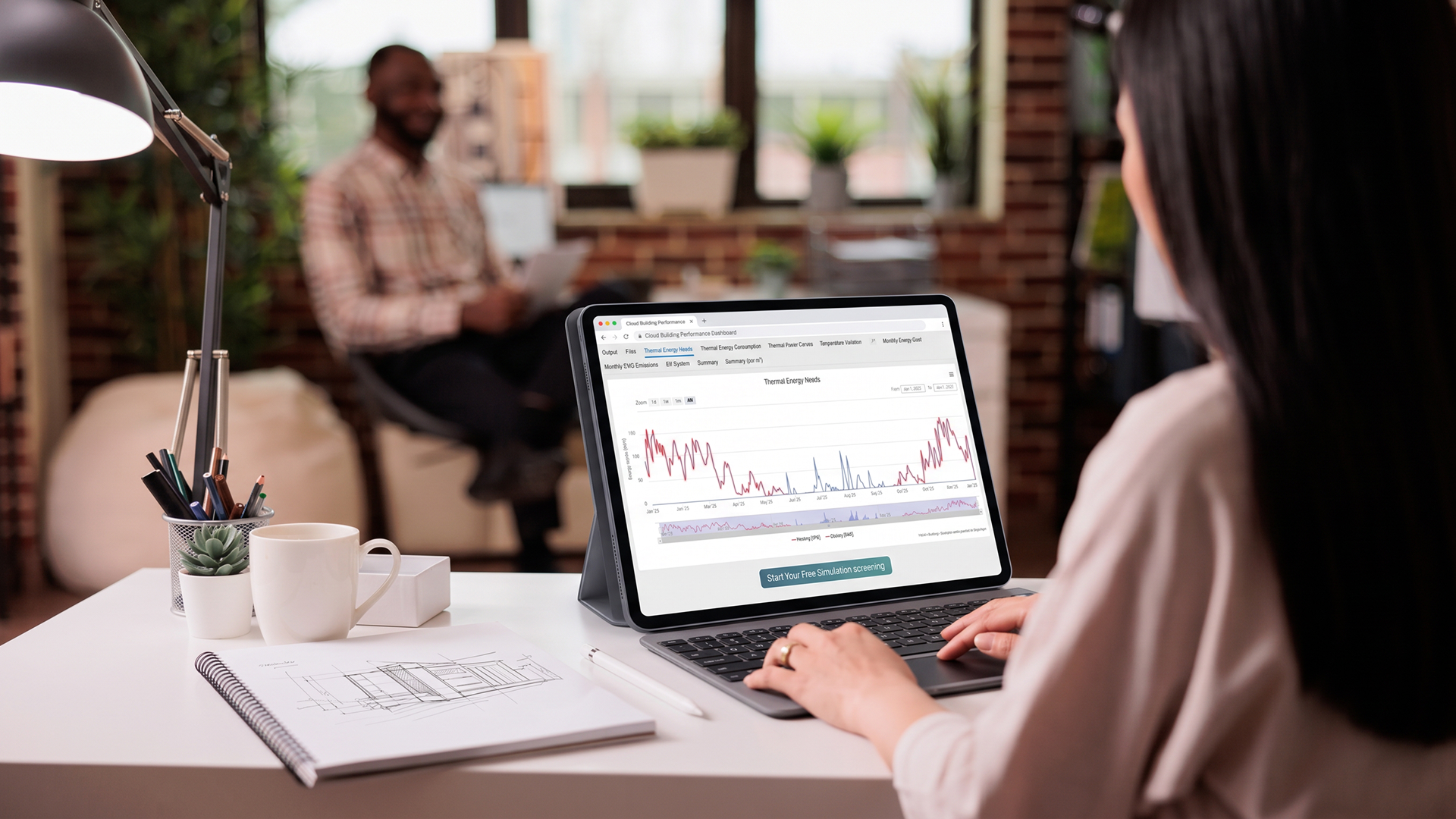
Running EnergyPlus online does not mean running a different, lesser engine. It means putting the same validated calculation core behind a structured web interface, so the model construction, the part that consumes days of expert time, is automated. You describe the building in the terms you actually know at design stage: location, size, shape, use, envelope quality. The platform builds the EnergyPlus model, runs the full dynamic simulation on cloud infrastructure, and returns results in minutes.
That distinction matters because the engine is where credibility lives. A simplified interface on top of a simplified calculation is a toy. A simplified interface on top of EnergyPlus is a workflow improvement.
Does simplification cost accuracy?
This is the fair objection, and it is the question the research behind FREDS set out to answer rather than assume. The platform’s simplified modelling approach was developed and tested at the University of Brighton, and benchmarked against fully detailed EnergyPlus models built by hand (Picco and Marengo, 2019).
The benchmark case was not a friendly one: a medium-sized private clinic in Bergamo, Italy. A building with complex occupancy, demanding internal conditions and real mechanical systems. Against the detailed model, the automatically generated cloud model produced heating results within 4.8% and cooling results within 14.0% . Both sit comfortably inside the 20% accuracy margin the research defines as acceptable for early-stage design decisions; the threshold below which a screening result and a detailed result would lead you to the same design choice. The difference between the hand-built simplified model and the automatically generated one was roughly within 2% even in the worst case.
In other words: the part of the process that was automated, the part that used to take expert days and costs almost nothing in accuracy.
Who this is for
Architects get energy feedback inside the design loop instead of after it. Test orientation, glazing ratio, envelope quality and more, while the options are still open, and bring quantified reasoning to client conversations.
Smaller engineering practices get dynamic simulation capability without the overhead of a dedicated simulation specialist or the software licenses that hire one. The expertise is encoded in the platform; the engineering judgment stays with you.
Developers and asset owners get feasibility-stage answers: can this site, this massing, this budget reach the energy target, at a cost and speed that makes testing several options realistic rather than theoretical.
Sustainability consultants get throughput. When a screening run takes minutes, you can afford to test the variants your judgment says are worth testing, instead of rationing simulation to the one design the client has already chosen.
What stays honest
Cloud screening does not replace detailed simulation, and a platform built by simulation researchers is not going to pretend otherwise. Compliance modelling, plant sizing and the fine-grained optimization of a frozen design still belong to detailed tools in expert hands and FREDS’s own consultancy work uses exactly those methods when the stage demands them. What the cloud platform does is occupy the stage those tools were never designed for: the early weeks, when the big decisions are made, when inputs are uncertain and when the alternative to a fast validated estimate is usually no analysis at all.
The numbers worth carrying out of this page are the benchmark ones: results within 4.8% of a detailed model on heating, inside a defined 20% screening margin, from a model that takes minutes rather than weeks to build. That is what the FREDS4Buildings cloud building energy modeling is for not replacing the expert, but making sure the expertise arrives early enough to matter.
Try it on a live project. FREDS runs a full dynamic EnergyPlus simulation from your browser, describes the building, and gets validated results in minutes. Start a free simulation
Related reading
Frequently Asked Questions
What does EnergyPlus online mean?
Is cloud building energy simulation as accurate as desktop EnergyPlus?
Is EnergyPlus free to use online?
Do I need to install any software to run EnergyPlus?
References
Written by Marco Picco, PhD co-founder of FREDS4Buildings and a building-physics lecturer at the University of Lancashire , whose work on building energy simulation has been published in Energy & Buildings , Building and Environment and the IBPSA Building Simulation conference proceedings. About Marco Picco
Reference: Picco, M. and Marengo, M. (2019). A fast response performance simulation screening tool in support of early stage building design. Proceedings of the 16th IBPSA Building Simulation Conference, Rome. View paper