
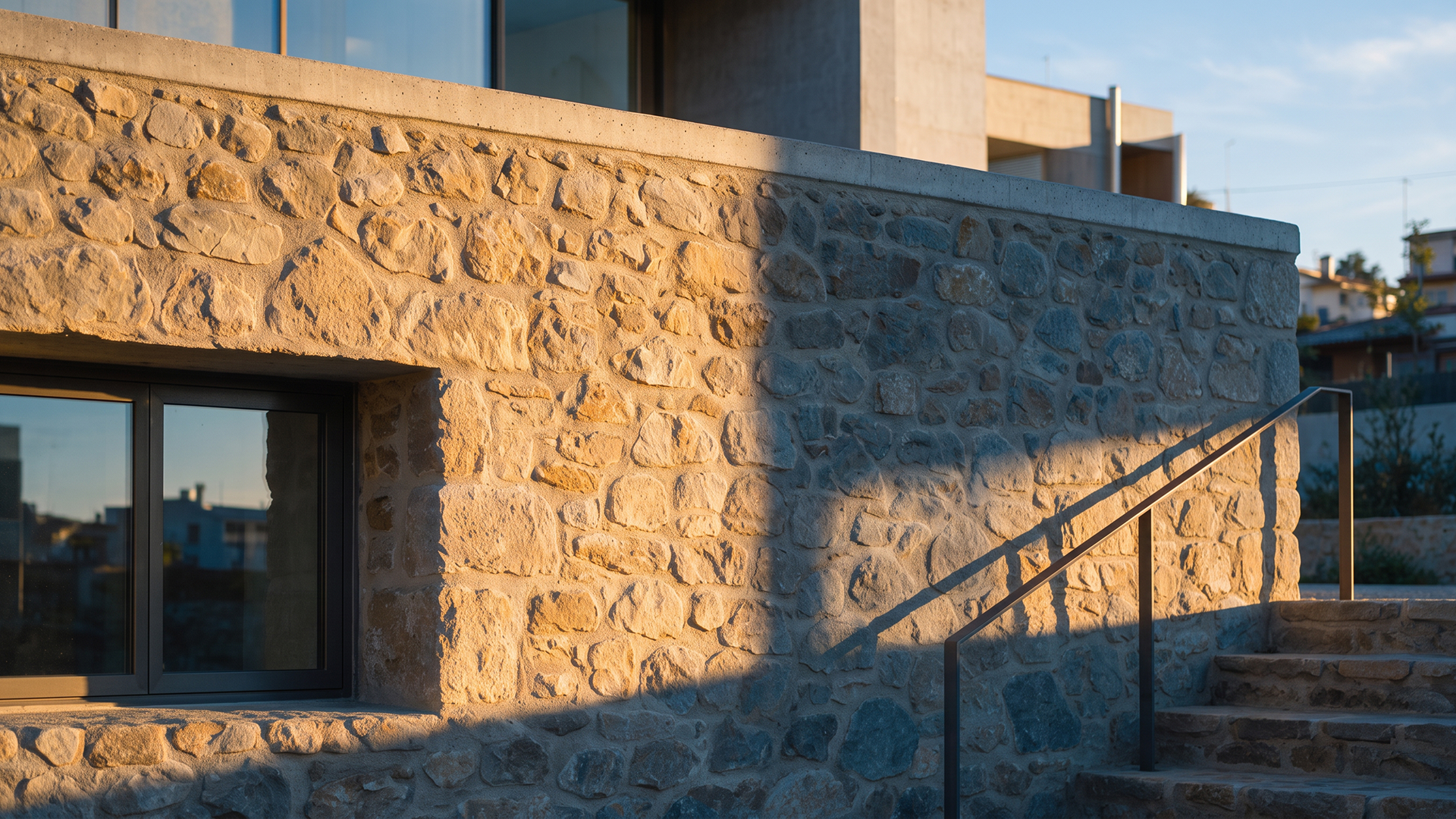
In short: U-value measures steady-state heat loss; it says nothing about how a wall behaves over a day. Dynamic thermal modelling captures what it misses and shows that in warm climates a high-thermal-mass envelope can deliver 12% fewer discomfort hours and 5% lower cooling demand than a lightweight wall of the same U-value (Rugani et al., 2021).
Ask the construction industry to describe a wall’s thermal quality and you will get one number back: the U-value. Decades of regulation have trained everyone, designers, regulators, clients to treat insulation level as a synonym for thermal performance. Lower U-value, better wall. End of conversation.
The trouble is that a U-value describes a wall in a situation that never occurs: steady state, with a constant temperature on each side, heat flowing at an unchanging rate. Real buildings live in a dynamic world sun rising and setting, temperatures swinging through the day, occupants and equipment pulsing heat into rooms. In that world, a second property matters as much as how much heat a wall lets through: how fast the wall responds. That property is thermal inertia in plain English, how slowly a construction heats up and cools down, its ability to absorb heat, hold it, and release it later.
A research team including FREDS founders quantified what this second dimension is worth, using dynamic thermal modelling across multiple climates, envelope types and uses (Rugani, Bigazzi, Fantozzi, Marengo, Picco and Salvadori, 2021). The findings are an inconvenience for anyone whose specification ends at the U-value.
Two walls, same numbers, different buildings
The study’s sharpest comparison holds the steady-state credentials still and varies only the mass behind them: envelopes with similar periodic transmittance the dynamic counterpart of U-value, describing how much of an external temperature wave gets through but very different internal heat capacity, the wall’s ability to soak up heat arriving from inside the room.
By the static paperwork, these constructions are near-twins. Under dynamic thermal modelling, they part company: the high-heat-capacity envelope produced noticeably fewer discomfort hours and a lower cooling load than its lightweight counterpart. Same compliance story, measurably different, building a difference no steady-state calculation can even express, because the quantity responsible for it does not appear in the steady-state method.
The mechanism is intuitive once named. A massive wall acts as a thermal flywheel: it absorbs the afternoon’s heat surge into its own bulk instead of passing it to the room, then releases it hours later when conditions are cooler. A lightweight wall with the same insulation simply has nowhere to put the heat. The study’s temperature traces make the consequence vivid in lightweight envelopes, free-running summer operative temperatures overshot the comfort range by as much as 7°C, oscillating with the day, while massive constructions rode through the same weather on a far flatter line.
Where dynamic thermal modelling shows inertia pays
The research is specific about geography and season, which is what saves it from becoming a new dogma to replace the old one.
Warm climates are where inertia earns its keep. The benefits are concentrated in the southern test locations and in summer, where external temperature swings are large and the daily cycle of absorb-by-day, release-by-night has real work to do.
Winter belongs to insulation. Nothing in the findings dethrones the U-value for limiting heating demand. Winter discomfort in poorly insulated envelopes remained severe regardless of mass. Insulation and inertia answer different questions; the error is letting the first question monopolise the specification.
The combination is the design. The strongest performers paired adequate insulation with high internal capacity and the study notes the inertia advantage shows most clearly in comparisons between non-insulated envelopes, while remaining material even between insulated ones.
The multiplier: night ventilation
The study’s most practically exciting result concerns what happens when thermal mass is paired with the cheapest cooling strategy in existence: night ventilation flushing the building with cool night air so the structure discharges its stored heat and starts the next day empty.
Mass and night air are natural partners, because ventilation can only cool what has actually accumulated heat. In the warm-climate test case (Brindisi, with July night-time air averaging around 23°C), night ventilation cut cooling energy by up to 17% and the comfort effect was starker still. With cooling systems operating, night ventilation reduced summer discomfort in heavyweight buildings by 90%, against only 40% in lightweight ones. Ventilated massive envelopes held summer discomfort below 10% of occupied hours; lightweight office cases exceeded 50% under the same strategy.
Read that as a design sentence: the same free, passive, zero-energy strategy is more than twice as effective when the building has mass to discharge. Specifying the envelope and choosing the cooling strategy are not separate decisions.
The takeaway
The U-value is not wrong; it is incomplete. It answers “how much heat leaks through?” and stays silent on “what happens when conditions change?” which, in a warming UK summer, is rapidly becoming the more expensive question. The research puts numbers on the silence: 12% of comfort, 5% of cooling, a 7°C overshoot, and a free cooling strategy whose effectiveness more than doubles with mass.
Specify with both numbers in view. And before committing an envelope, run it forward through a real year. It now takes less time than reading this article did.
Compare envelope options dynamically in FREDS heavyweight vs lightweight, with night ventilation on and off in minutes, from your browser. Test your envelope
Related reading
Frequently Asked Questions
What is the difference between U-value and thermal inertia?
Why is U-value alone insufficient for thermal comfort?
Does thermal mass help in all climates?
How much does night ventilation improve thermal comfort?
References
Written by Marco Picco, PhD co-founder of FREDS4Buildings and a building-physics lecturer at the University of Lancashire, whose work on building energy simulation has been published in Energy & Buildings , Building and Environment and the IBPSA Building Simulation conference proceedings. About Marco Picco
Reference: Rugani, R., Bigazzi, M., Fantozzi, F., Marengo, M., Picco, M. and Salvadori, G. (2021). Impact of building thermal inertia in different climates using energy dynamic simulation through a simplified description model. Proceedings of Building Simulation 2021 (IBPSA). View paper