In short: A net-zero building certified today is judged against today’s weather but it will operate into the 2080s. When researchers stress-tested a UK net-zero home against 2080 climate files, it held: no significant overheating in any scenario and roughly 89% lower emissions than a conventional design, albeit with the necessity of a cooling system. The resilience was a finding, not a guarantee of the label which is what net zero building design software must be able to verify (Viganò et al., 2024).
Net zero is a promise with a timestamp problem. A building certified as net-zero today earns the label against today’s conditions, today’s weather, today’s heating season, and today’s negligible cooling demand (in UK). The promise is implicitly lifelong: clients, investors and regulators all read net-zero building as a property of the asset, not of its opening year. So the question that actually matters is rarely asked at design stage: will the energy balance that works in 2026 still work in 2080, in a climate that will be measurably different?
Research by a University of Brighton-led team including FREDS founders asked it directly (Viganò, Rugani, Marengo and Picco, 2024). The study took two versions of the same UK residential building a conventional design meeting current UK regulations, and a net-zero alternative and simulated both under current weather and under projected conditions for 2030, 2050 and 2080, in Exeter, Manchester and Aberdeen, using EnergyPlus and the Freds4Buildings platform with Prometheus and Meteonorm future weather data.
The short answer is encouraging. The honest answer has a condition attached, and the condition is the point of this article.
The two contenders
The reference building represents good current practice: a design compliant with present UK energy regulations, of the kind being approved across the country this year. One variant adds mechanical cooling, so the study could observe future cooling loads rather than just future discomfort.
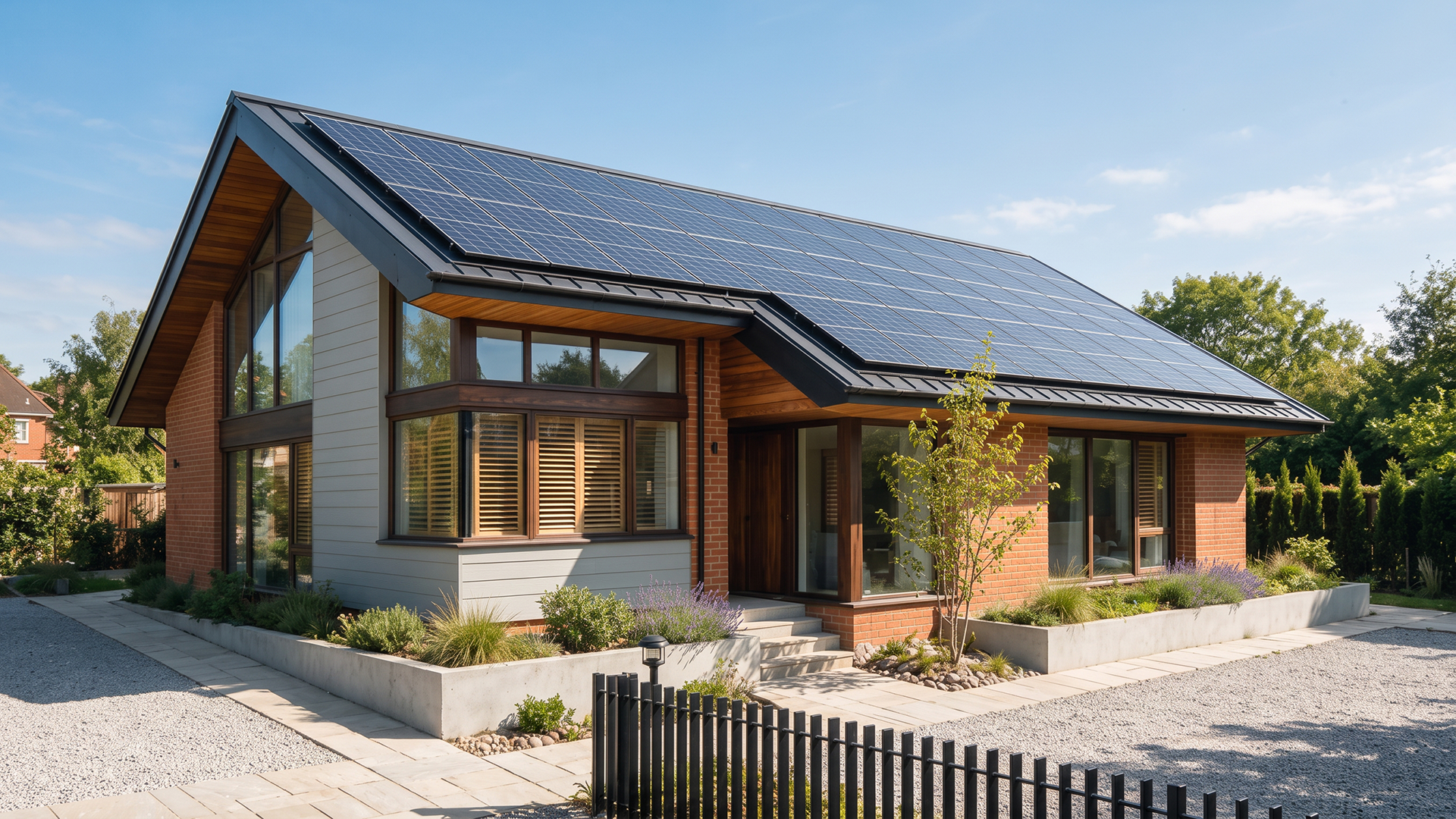
The net-zero energy building pushes further: a highly efficient envelope, a water-ground source heat pump in place of combustion, and a 300 m² monocrystalline rooftop photovoltaic array sized for on-site generation to balance consumption specified from the UK net-zero design guidance and real supplier data, not idealised components.
Same form, same locations, same future weather files. What differs is design philosophy which makes the divergence between them attributable to design, not circumstance.
What 2080 does to each
The conventional building degrades on every axis. As covered in detail in our future-climate article, its heating demand eases (down around 20% by 2080) but its cooling demand explodes rising by 203% to 700% depending on configuration and location and where no cooling exists, the building begins to fail the standard overheating criteria outright, with Exeter crossing the 3% occupied-hours threshold from as early as 2050. The design remains legal against the weather it was certified with, and becomes increasingly unfit for the weather it will actually experience.
The net-zero building bends without breaking. Its loads shift with the climate too, efficiency is not immunity, and cooling needs grow as summer’s heat. The design absorbs the change: consumption stays far below the conventional building throughout, the overheating analysis shows no significant risk in any location or scenario, and across the full time horizon the NZEB maintains roughly 89% lower greenhouse gas emissions than its conventional counterpart even as the cooling burden rises. The efficient envelope blunts the new summer loads; the heat pump meets demand at a fraction of the energy; the PV array keeps covering the balance.
The study’s conclusion is worth quoting in spirit: accounting for future weather both exposes the risks of conventional design and verifies that net-zero designs can hold their targets across their entire lifespan. Net zero, done properly, is not just a carbon strategy it is a climate resilience strategy. The same fabric-first, low-demand logic that eliminates emissions today is what will keep the building comfortable and the energy balance intact in the 2080s.
The condition: "verified" is doing the heavy lifting
Here is the part the headline hides. The NZEB in this study did not turn out to be resilient by luck or by virtue of the label. Its resilience is a finding established because the researchers did something almost no real project does: they simulated the design against weather that has not happened yet.
Strip that step away and the picture changes. A net-zero design certified only against historical weather carries unexamined risks of exactly the kind the conventional building exhibited: PV generation sized against one climate serving the loads of another; a heating-optimised energy balance meeting summers it was never tested on; comfort margins that exist on paper because the paper describes the past. Some net-zero designs would pass the 2080 test anyway. The uncomfortable truth is that without running it, nobody knows which ones and the label says nothing about it.
This reframes what net zero building design software actually needs to do. Compliance arithmetic against today’s standards is table stakes. The differentiating capability is the stress test: dynamic simulation of the specific design under future weather files morphed, transparent, benchmarkable projections of 2050 and 2080 (the methodology, published by the same research group, is covered in our future-climate article) with overheating assessed zone by zone against occupied-hours criteria. That is the analysis that converts net-zero from a certificate about the opening year into a defensible claim about the asset’s life and it is the test any credible net zero building design software should make routine.
What to ask of any net zero building design software
Distilled into the questions a client, investor or design team should put on the table:
- Against which weather was this design verified? If the answer is only a historical typical year, the lifelong claim is untested.
- What happens to the energy balance in 2050 and 2080? Generation, consumption and the gap between them, per scenario three numbers per horizon.
- Does any zone cross the overheating threshold under future weather? Floor by floor, because the research shows failure arrives unevenly.
- What is the marginal cost of finding out? With cloud-based simulation and published future-weather workflows, the honest answer is now: minutes per scenario. The stress test has no remaining excuse.
The takeaway
Will your net-zero building still be net-zero in 2080? The research says: it can measurably, with the 89% emissions advantage intact and zero overheating across every scenario tested but “can be” was earned in that study the only way it can be earned on a real project: by putting the design in front of the future and watching how it performs.
Net zero is a fifty-year promise. It deserves a simulation that looks fifty years ahead.
Want to stress-test your net-zero design against future climate scenarios? Energy balance, emissions and zone-by-zone overheating assessment against 2050 and 2080 weather are currently available through FREDS consultancy services. Talk to the team
Related reading
Frequently Asked Questions
Will a net-zero building designed today still be net-zero in 2080?
Why might a net-zero building fail in the future?
What should net zero building design software be able to do?
How does a net-zero design stay resilient as the climate warms?
References
Written by Marco Picco, PhD co-founder of FREDS4Buildings and a building-physics lecturer at the University of Lancashire, whose work on building energy simulation has been published in Energy & Buildings , Building and Environment and the IBPSA Building Simulation conference proceedings. About Marco Picco
Reference: Viganò, G.S.M., Rugani, R., Marengo, M. and Picco, M. (2024). Assessing the impact of climate change on building energy performance: a future-oriented analysis on the UK. Architecture, 4(4), 1201–1224. View paper